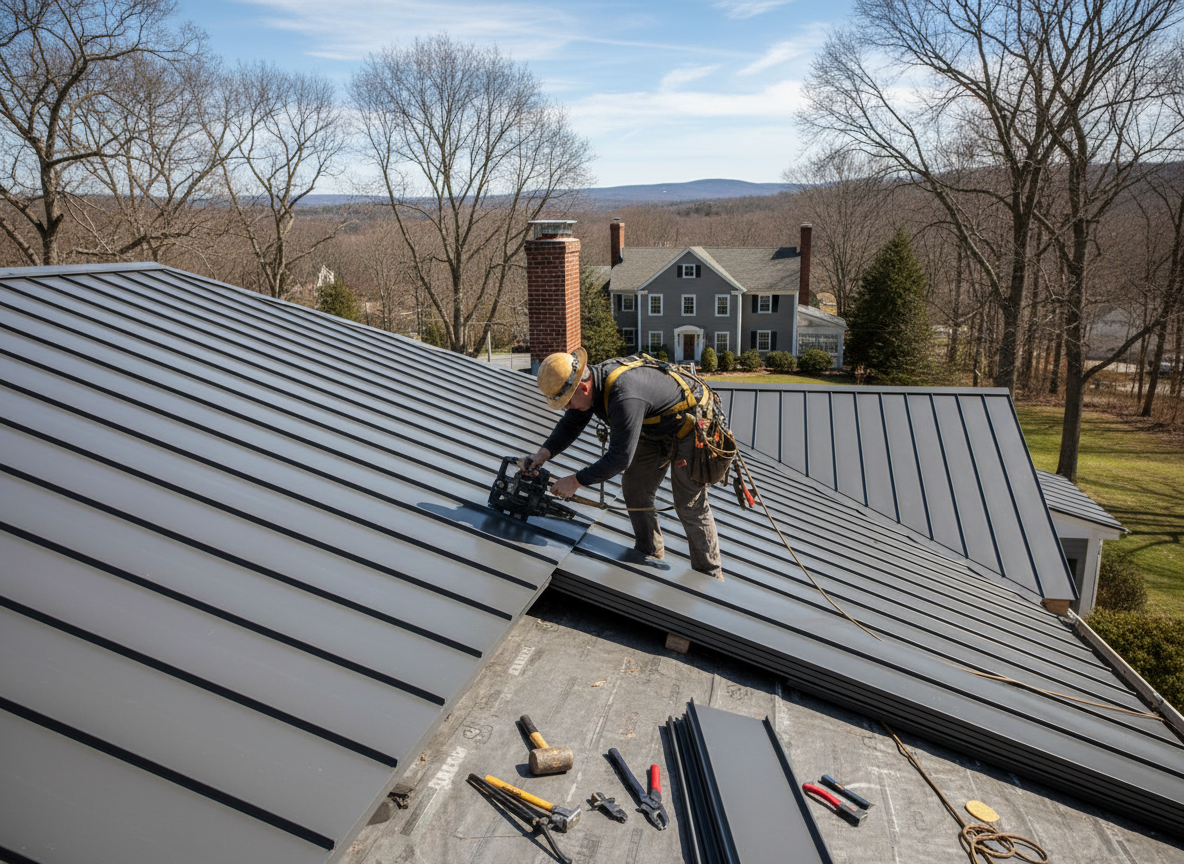
Metal roof installation in Acton requires attention to the town's humid continental climate, where cold winters bring heavy snow and ice that can stress seams and fasteners. Homes in Acton Center and the Great Road Historic District often feature older framing that demands careful underlayment and ventilation choices to prevent condensation in the attic spaces during warm summer swings. Crews working from the base at 145 Great Rd STE 6 routinely check for proper slope and ridge detailing because even modest pitches in West Acton properties can trap meltwater if panels are not aligned precisely.
In Middlesex County neighborhoods like South Acton and East Acton, metal systems must handle wind-driven rain common near the Concord and Littleton borders. Installers select gauges and coatings that resist corrosion from the area's freeze-thaw cycles while maintaining snow-shedding performance. Boxborough-adjacent jobs frequently involve coordinating with existing chimneys and dormers on 19th-century stock, where custom flashing prevents leaks that standard asphalt replacements often miss after a few seasons.
Proper attachment patterns change with the terrain around the Acton Arboretum, where tree cover increases shade and moisture retention on north-facing slopes. Technicians account for thermal expansion in long panel runs because summer heat followed by sudden winter drops can shift seams if clips are spaced incorrectly. These details keep the roof performing through repeated cycles without the callbacks common in less climate-specific work.
Technician insight
In Acton, the thing that catches most people out with metal roof installation is underestimating how quickly ice dams form on the north slopes of homes in Acton Center during our long winters; the metal sheds snow well but needs aggressive ice-and-water shield and ridge ventilation or meltwater backs up under the panels faster than on asphalt.
South Acton Metal Roof
Homeowner in South Acton called after repeated leaks around a dormer during spring thaw. We found inadequate flashing and compressed insulation blocking airflow. Installed new metal panels with extended step flashing and added a continuous ridge vent. The roof now sheds snow cleanly and the attic stays dry through freeze-thaw cycles.
How it works
- 1
Site Assessment
Measure roof planes, note existing ventilation, and check framing condition in Acton homes.
- 2
Material Selection
Choose panel profile, gauge, and color suited to snow load and historic district guidelines.
- 3
Underlayment and Flashing
Install ice-and-water shield at eaves and valleys plus custom step flashing around penetrations.
- 4
Panel Installation
Fasten panels with expansion clips and seal seams to handle winter temperature swings.
- 5
Final Inspection
Verify ridge vents, gutters tie-in, and walk the roof for missed fasteners before sign-off.
Pricing
Cost depends on roof size, panel type, access in older Acton neighborhoods, and any framing repairs uncovered during tear-off.